Source: Atlantic Union Bank Financial Insomnia Research, a national survey of 1,973 U.S. consumers fielded in July 2026.
New national survey finds financial worry is widespread across age groups and income levels, while revealing what Americans need most to feel financially confident
Key Findings
- Money is the No. 1 thing keeping Americans awake at night.
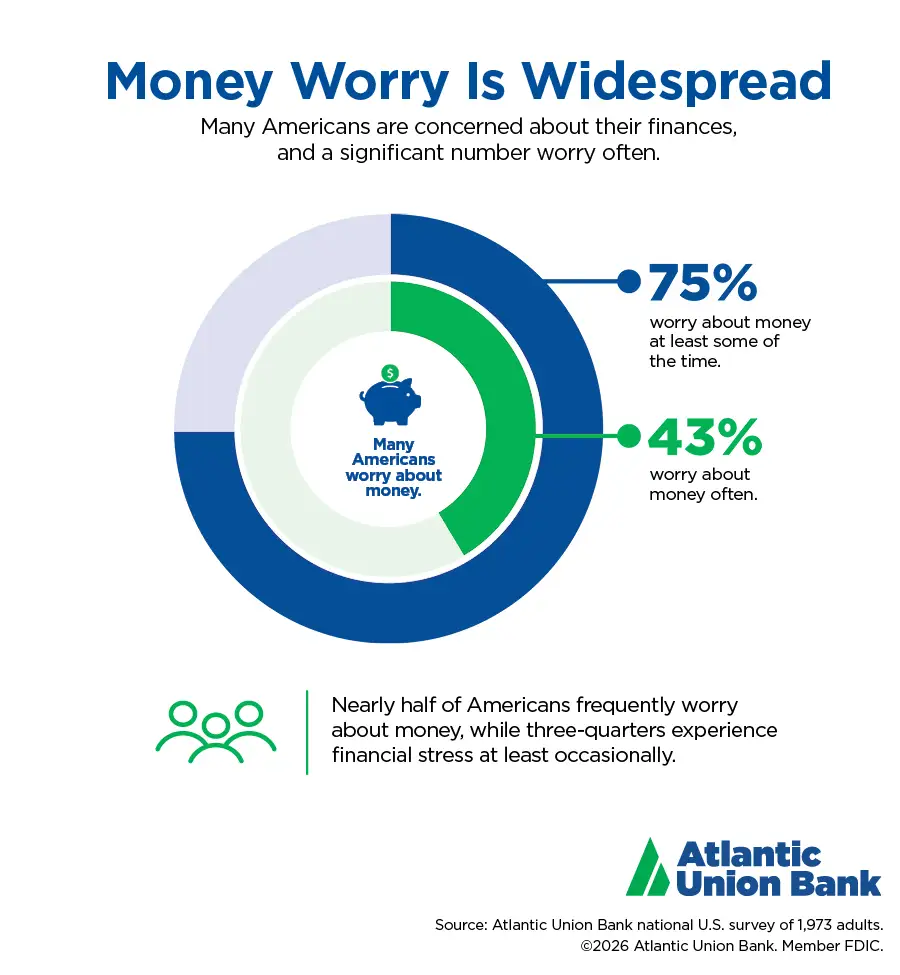
- Three in four Americans worry about money at least some of the time.
- Financial stress extends across age groups and income levels, including many higher-income households.
- Savings, steady income and clear planning are the strongest drivers of financial confidence.
Ask Americans what keeps them up at night and the answer, overwhelmingly, is money. A new national survey of 1,973 U.S. consumers conducted by Atlantic Union Bank found that money or finances rank above family, health, job security, personal relationships and global events as the leading cause of lost sleep, known as financial insomnia. But the findings reveal a broader story than financial stress alone. The data shows that money worries affect Americans across generations and income levels, influence how people seek help and shape what they need to feel secure about their financial futures.
By the Numbers
- 58% say money or finances keep them up at night, more than any other category tested, ahead of family or children (42%), health concerns (38%), job or work (33%), personal relationships (29%), the national or global economy (24%) and national or global events (23%).
- 75% are concerned about money at least sometimes, and 43% worry about it often, the highest "often" score of any category tested.
- 38% often worry about making the best money decisions, 37% often worry about saving for the future and 35% often worry about covering bills and regular expenses. These are the three most persistent financial anxieties measured.
- 27% often think about protecting themselves from fraud or scams, while only 9% say they never think about it.
Financial Stress Touches Every Generation
Financial worry is widespread across every age group surveyed.
| Age Group | Say Money Keeps Them Up at Night |
|---|---|
| 18-34 | 69% |
| 35-54 | 63% |
| 55-64 | 52% |
| 65-74 | 36% |
While concern is highest among adults ages 18-34, the majority of adults through age 74 report losing sleep over money. The data shows that financial stress is not isolated to a single generation. Rather, it remains a significant concern across much of adulthood before declining among older respondents.

Financial Worry Doesn't Disappear with Higher Income
The survey also challenges the assumption that higher income automatically leads to financial peace of mind.
Worry generally declines as income rises, but the relationship is not straightforward. Financial worry does not drop meaningfully until household income exceeds $200,000, where fewer than four in ten respondents say money keeps them up at night.

What Specifically Keeps Americans Awake
When respondents described their financial concerns in their own words, the most common themes centered on everyday financial realities.
- 38% point to covering basic expenses.
- 20% cite insufficient income.
- 12% reference cost of living and inflation.
- 12% describe a general lack of money.
- 10% indicate retirement readiness.
- 7% name debt burden.
Respondents' financial concerns focused more frequently on immediate financial needs, such as basic expenses and income, than on long-term concerns such as retirement. Concerns about bills, income and emergency preparedness appear far more frequently than worries about investments or the stock market.
Americans Still Turn to People for Help
When financial worries arise, most respondents seek guidance from other people.
- 51% turn to a family member.
- 38% consult a professional.
- 34% talk to a friend.
- 34% use AI or online search.
- 22% ask social media.
Use of AI and online search varies significantly by age, with younger adults much more likely to rely on digital resources. However, across all respondents, family members, professionals and friends remain the most common sources of financial support.
What People Want When They Ask for Help
When seeking financial guidance, respondents say they are looking for more than information alone.
- 55% want factual answers.
- 52% want advice on getting back on track.
- 49% want reassurance that they're doing the right thing.
- 45% want resources to learn more.
- 38% want a step-by-step plan.
The findings suggest that confidence and clarity are nearly as important as financial knowledge. Many respondents are looking for practical direction and reassurance in addition to facts and resources.
The Surprisingly Simple Formula for Financial Confidence
When asked what makes them feel most confident about their finances, respondents pointed to a handful of consistent themes.
- Savings or an emergency fund (23%)
- A steady income or working more hours (19%)
- Budgeting, tracking and smart spending (14%)
- Good investments, retirement accounts or a pension (10%)
- Professional financial planning or advice (10%)
The data suggests that financial confidence is built less on wealth accumulation and more on stability, preparedness and predictability. A steady paycheck, accessible savings and a manageable budget are among the strongest contributors to financial peace of mind.
What People Wish They'd Known Sooner
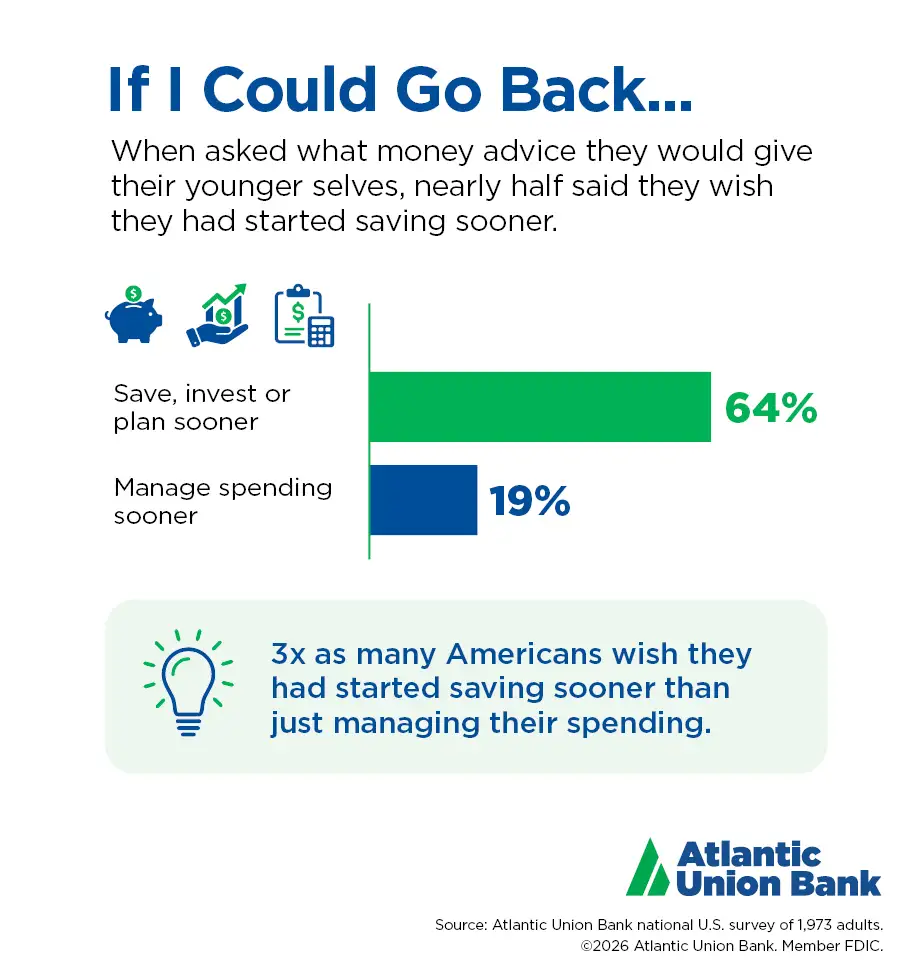
Asked what financial advice they would give their younger selves, respondents revealed a common theme.
- Save/invest/plan sooner (64%)
- Manage spending sooner (19%)
- Avoid debt (7%)
Three times as many respondents say they wish they had started saving sooner, making it by far the most common financial lesson people would share with their younger selves.
This research is part of Atlantic Union Bank’s broader effort to help consumers and businesses navigate the financial concerns that affect people across generations, income levels and life stages. As the findings show, while financial worries may differ from person to person, the desire for financial stability, practical guidance, trustworthy answers and a clearer path forward is nearly universal. To help meet those needs, AUBHelpsYouSleep.com serves as a resource hub featuring banker insights, answers to common financial questions, money management tools and services and practical guidance designed to build financial confidence. Visitors can also access branded YouTube sleep ambience tracks inspired by the sounds of money, banking and commerce, extending the campaign’s message that greater financial understanding can contribute to greater peace of mind. Atlantic Union Bank is here to help. Our tools and bankers are committed to helping you get back to sleep.
Methodology
Atlantic Union Bank surveyed 1,973 U.S. consumers nationally in July 2026 to measure the frequency and intensity of financial worry relative to other life priorities and to understand how people seek help when they have financial questions or concerns. Respondents were split roughly evenly across age brackets from 18 to 74 and across household income levels from under $25,000 to $200,000 or more. Household income was not adjusted for geography.